Short answer: What is OnlyFans? It is a paid website where adults sell photos and videos of themselves to subscribers, and much of what sells there is pornography. Its own rules say nobody under 18 can use it. But in November 2026, a report by two campaign groups, CEASE in the UK and Collective Shout in Australia, found that popular OnlyFans performers use ordinary TikTok videos about make-up, shopping and pets to show teenage girls a life of easy money, with coded hints pointing to their explicit content elsewhere. TikTok lets children join at 13. That gap is one of the reasons Kids n Clicks suggests waiting until 16 for social media.
In short:
- What is OnlyFans? An 18+ subscription site, launched in 2016, best known for explicit content.
- Its performers cannot advertise it openly on TikTok, so they hide hints in lifestyle videos, such as the word “corn” in place of “porn”.
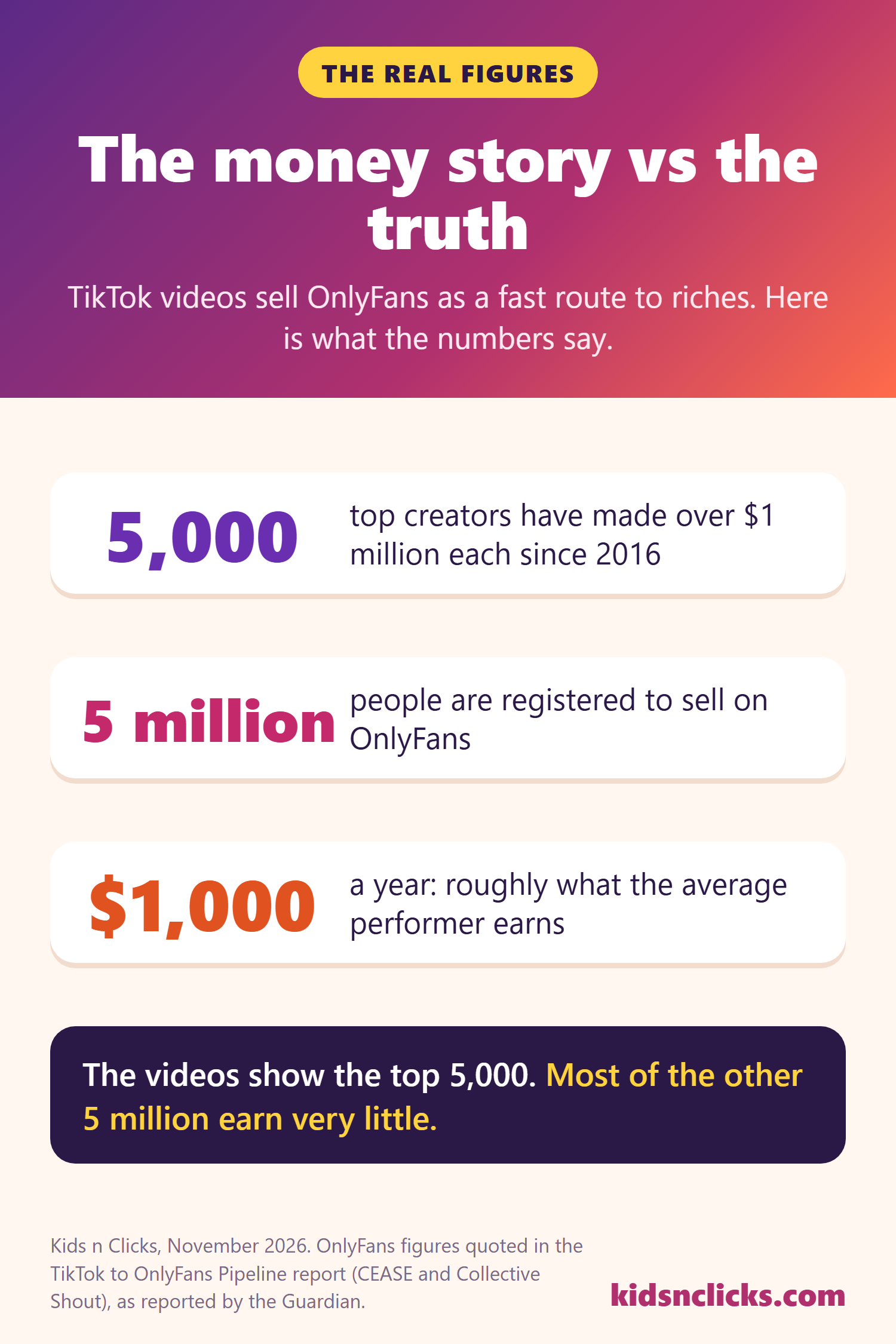
- The videos sell a story of freedom, friends and fast money. OnlyFans’ own figures, quoted in the report, put the average performer’s earnings at about $1,000 a year.
- Kids n Clicks suggests waiting until 16 for social media. Australia already bans under-16s, and the UK plans to from late spring 2027.
- Families do not have to wait for the law. Talk about what turns up in the feed, and choose 16 at home today.
If your child has asked you “what is OnlyFans?”, or you have seen the name in their feed, this post explains the site, the new research about TikTok, and why it adds to the case for keeping children off social media until 16. It covers what children see on their phones rather than the rights and wrongs of adult sex work.
What is OnlyFans?
OnlyFans is a pay-to-view site. Fans pay creators a monthly fee for photos and videos. It is best known for pornography.
It is for adults only. OnlyFans’ terms set the minimum age at 18. In March 2025, Ofcom fined the company behind OnlyFans £1.05 million for giving it wrong information about its age checks.
So what is OnlyFans, for a parent? A site your child should not be on, whose stars your child may already know from TikTok.
What the news says about TikTok and OnlyFans
On 7 November 2026, the Guardian reported on a new study called the TikTok to OnlyFans Pipeline. Researchers from CEASE (the Centre to End All Sexual Exploitation) and Collective Shout spent a year watching the non-explicit TikTok videos of some of OnlyFans’ most popular young female performers. They then followed whatever TikTok’s recommendations offered them next.
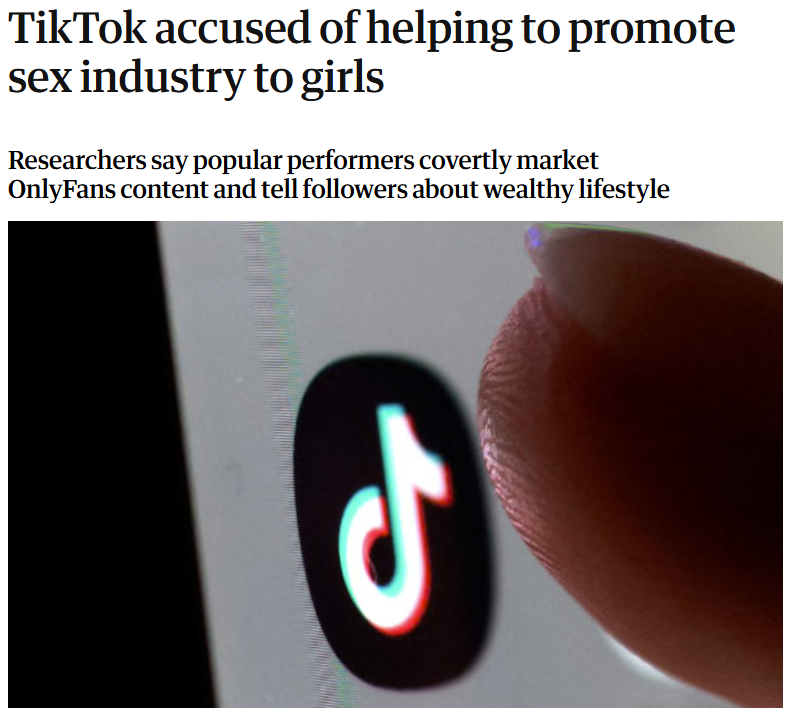
Screenshot: The Guardian, 7 November 2026
The researchers found coded references to pornography buried in what they called “girly lifestyle content”. Collective Shout says it commissioned the work because performers such as Sophie Rain and Ari Kytsya have a huge following among teenage girls on TikTok. Melinda Tankard Reist of Collective Shout called TikTok “an industrial-scale digital pimp”.
Both companies replied. A TikTok spokesperson told the Guardian that TikTok “strictly prohibits the sharing or showing of sexual content” and that its systems aim to keep age-inappropriate content away from teens. An OnlyFans spokesperson said the site is for people aged 18 and over and has strict sign-up checks to keep children out.
Collective Shout’s page on the report has details of its launch on 9 November 2026.
How do OnlyFans stars reach girls on TikTok?
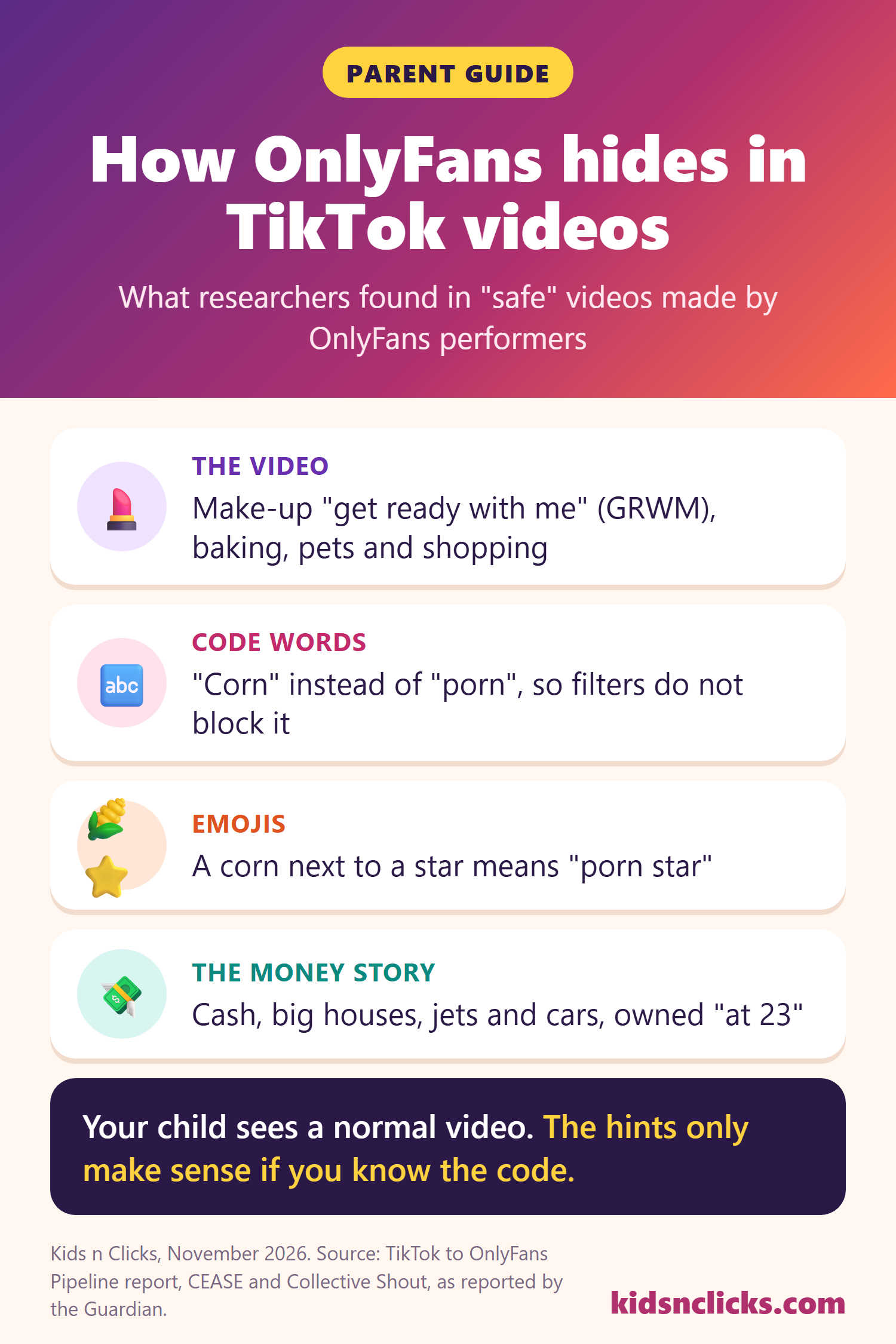
TikTok bans sexual invitations, and it does not let accounts link straight to OnlyFans or even mention it. Performers need TikTok followers to build their business, so the report found they have become skilled at hinting instead.
A typical video looks harmless. A young woman films her hair and make-up for a “get ready with me” post, known as GRWM. She bakes, plays with her dog or shows off a shopping haul. The hints sit inside it: the word “corn” in place of “porn”, a corn emoji next to a star emoji, a crude gesture, or a joke that only makes sense to someone who already knows where her other content is.
Some performers also run brand deals on TikTok. The Guardian reported that L’Oréal made Ari Kytsya, who calls herself a “mattress actress”, an ambassador for its Urban Decay make-up brand in 2025. Urban Decay is popular with teenagers, and those adverts reached millions of TikTok views.
Once a child watches one of these videos, TikTok’s feed learns from it. Parven explains how that works, and why a feed keeps serving more of the same:

What is the Bop House?
The Bop House is a luxury house in Miami where a changing group of women make content for OnlyFans together. Sophie Rain became famous through videos filmed there. The Guardian reported that the Bop House shares its auditions on TikTok, and that hopefuls reply by posting sexually suggestive dances tagged with its recruitment posts. For a teenage girl scrolling TikTok, that can look like a talent contest rather than a casting call for the sex industry.
What is OnlyFans selling to girls on TikTok?
The report says the strongest message across the videos is that selling sexual content on OnlyFans brings “a fabulous life”, full of freedom, fun, friends and money. Posts show piles of cash, big houses, private jets and expensive cars. One caption the researchers found read “how it feels knowing I own all of this at 23 thanks to 250,000 men”.
Some performers tell rags-to-riches stories, where OnlyFans rescues a young woman and her struggling family from poverty. The figures tell a different story.
The videos never show what a teenager cannot see from the outside: that strangers can copy, share and keep any image sold online, and that it can turn up again years later.
Why delay matters
Children can join TikTok at 13. OnlyFans is for adults over 18. So girls as young as 13 can watch these videos, even though the site behind them is for adults only.
The videos stay on TikTok because they show nothing explicit and never name OnlyFans.
A 13 year old may not realise that a make-up video is really an advert for selling sexual content. That gets easier to spot with age. That is why Kids n Clicks suggests waiting until 16 for TikTok, Snapchat, Instagram and the rest.
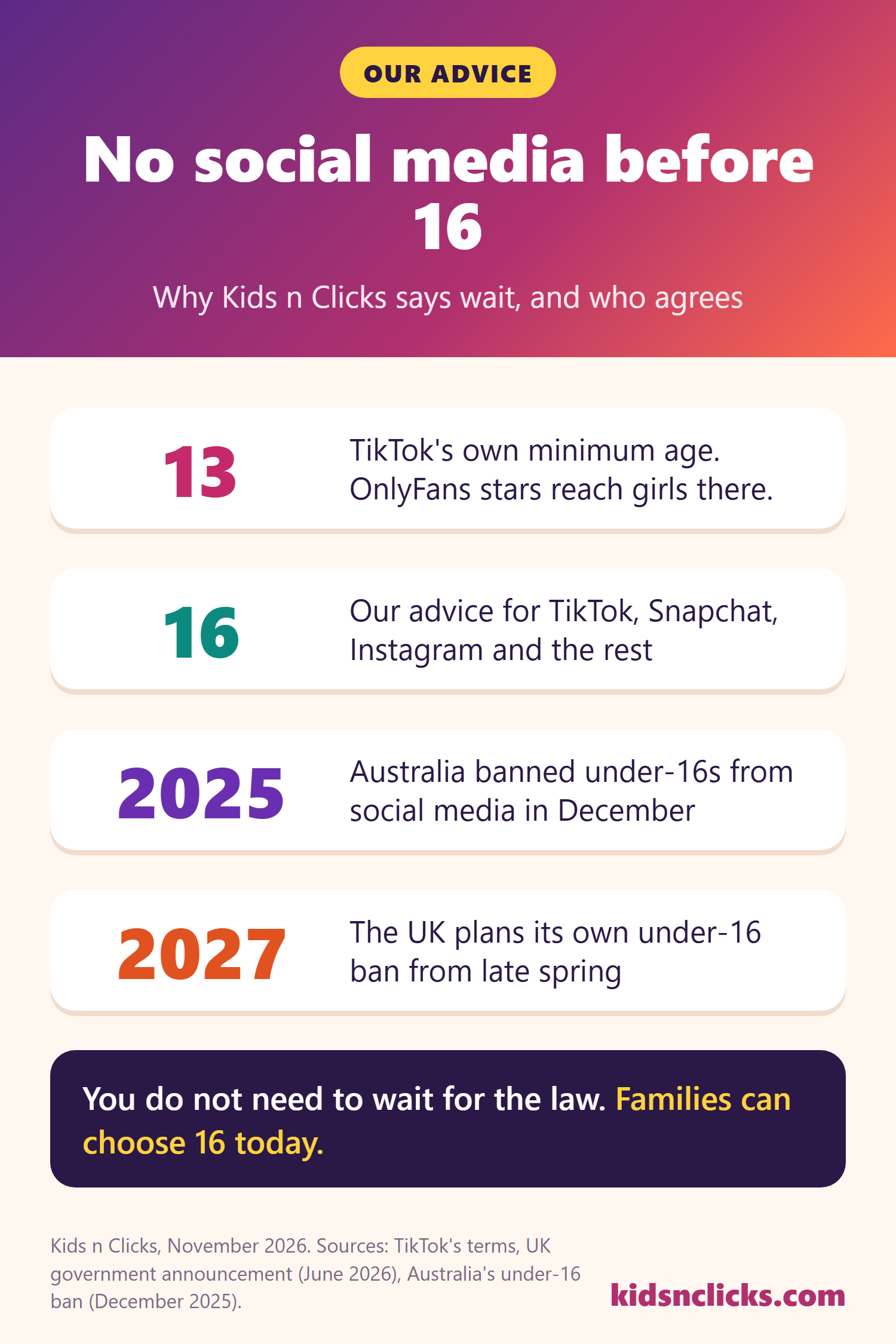
Some governments now take a similar view. Australia’s ban on under-16s has applied since December 2025. In June 2026, the UK government announced that under-16s will lose access to Snapchat, TikTok, YouTube, Instagram, Facebook and X, with the ban expected from late spring 2027. Our Snapchat age limit post lists the other countries that now restrict social media for children.
Bans have critics. Amnesty International UK and some children’s charities argue that apps should remove harmful features instead, because children find ways round age checks. A delay at home does not depend on the law, though. Parents can choose 16 today, and a child who reaches TikTok at 16 meets videos like these with three more years of judgement behind them.
Why does this matter for children?
Children meet sexual content online young. The Children’s Commissioner for England found in 2023 that one in ten children had seen pornography by age nine, and more than a quarter by age eleven. The average age of first viewing was 13. Read the Children’s Commissioner’s report.
The TikTok videos in this report are not pornography. Because they are not explicit, they stay on TikTok, where children can see them. The report’s authors want the age limits that already apply to pornography in many countries to cover posts that advertise the sex industry too.
The pattern will feel familiar to parents of boys. Our post on Andrew Tate shows how his clips sell boys a dream of money and fast cars, with harmful ideas about women packaged inside it. The TikTok to OnlyFans pipeline sells girls a similar dream, with the sex industry packaged inside.
What your child might see, and what it means
| What your child might see | What it can mean | A calm thing to say |
|---|---|---|
| The word “corn”, or a corn emoji next to a star | A code for porn and porn star, used to get past TikTok’s filters | “Do you know why people write corn instead of the real word?” |
| A GRWM video with jokes your child laughs at but will not explain | The jokes may point to adult content sold elsewhere | “What’s the joke? I don’t get it.” |
| Captions about earning thousands, owning a house or a car at 23 | The money story the report found again and again | “How many people do you think actually earn that?” |
| Auditions or dance challenges tagged Bop House | Recruitment for a house that makes OnlyFans content | “Do you know what that house actually makes?” |
How to talk to older children about OnlyFans
These conversations work best with older children and teenagers, who are the ones most likely to see these videos or hear about them from friends.
Answer the question plainly. If your teenager asks “what is OnlyFans?”, tell them the truth: an adults-only site where people sell sexual photos and videos. A calm, honest answer keeps them coming to you rather than to a search engine.
Ask before you tell. Ask which creators your older child likes and what those creators post. They may know names such as Sophie Rain and the Bop House better than you do. Let them explain first, and you will learn what their friends’ feeds actually show, even if your child is not on social media yet.
Talk about the money, not just the sex. The videos present OnlyFans as a business, not as pornography. Ask how many people your teenager thinks earn the sums in the videos, then share the real figures: about $1,000 a year on average, according to the report. Questions about money open the door to everything else.
Say the hard part plainly. Explain that anyone can copy, share and keep an image sold or sent online, and that some people use them to blackmail young people. Our post on sextortion explains how that crime works and what to do.
Do not shame the women or your child. If a conversation turns into a lecture about the performers, your child will stop telling you what they see. Keep the focus on the companies and the money behind the videos.
Explain why you are waiting. Older children accept a limit more easily when they know the reason. This report gives you a concrete one: TikTok lets them in at 13, and some of the people waiting there are selling something meant for adults.
Keep the door open. Tell your child that if anyone online asks them for photos, offers them money or invites them to “audition”, they can tell you and they will not lose their phone for it.
If your child is 16, or already on TikTok
Many children already have TikTok before 16. If yours does, the settings below cut the risk, and they matter just as much on your child’s 16th birthday.
TikTok’s Family Pairing links a parent’s TikTok account to a child’s, so you can turn on Restricted Mode, filter keywords out of their feed, set screen time limits and limit who can message them. TikTok explains each setting in its guardian’s guide.
Now that you know what is OnlyFans and how its stars advertise on TikTok, use the keyword filter for terms such as “corn” and “Bop House”, and sit down with your child to set it up together. Settings help, but the report shows that hints are built to slip past filters. Your conversation with your child does more than any setting.
Social media and online safety training
Our TikTok, Snapchat and Trending Social Media Deep Dive covers this properly: how TikTok’s recommendations decide what a child sees next, the coded words and trends that slip past filters, and how to make the case for waiting until 16.
It is a practical session that takes parents inside the apps their children use, rather than another list of online risks. It lasts one hour, runs online, and has no minimum or maximum group size, so it works for schools, parents’ groups, community organisations and employers who want to support the working parents in their team.
If you run a school, a parents’ group or a workplace, book the social media session here or connect with Parven on LinkedIn.
Parven Kaur is a digital parenting and online safety expert, and the founder of Kids n Clicks. She won the Scottish Cyber Security Award, and she sits on the National Board of Advisors for Barnardo’s Scotland.
Was this helpful?
Good job! Please give your positive feedback
How could we improve this post? Please Help us.