
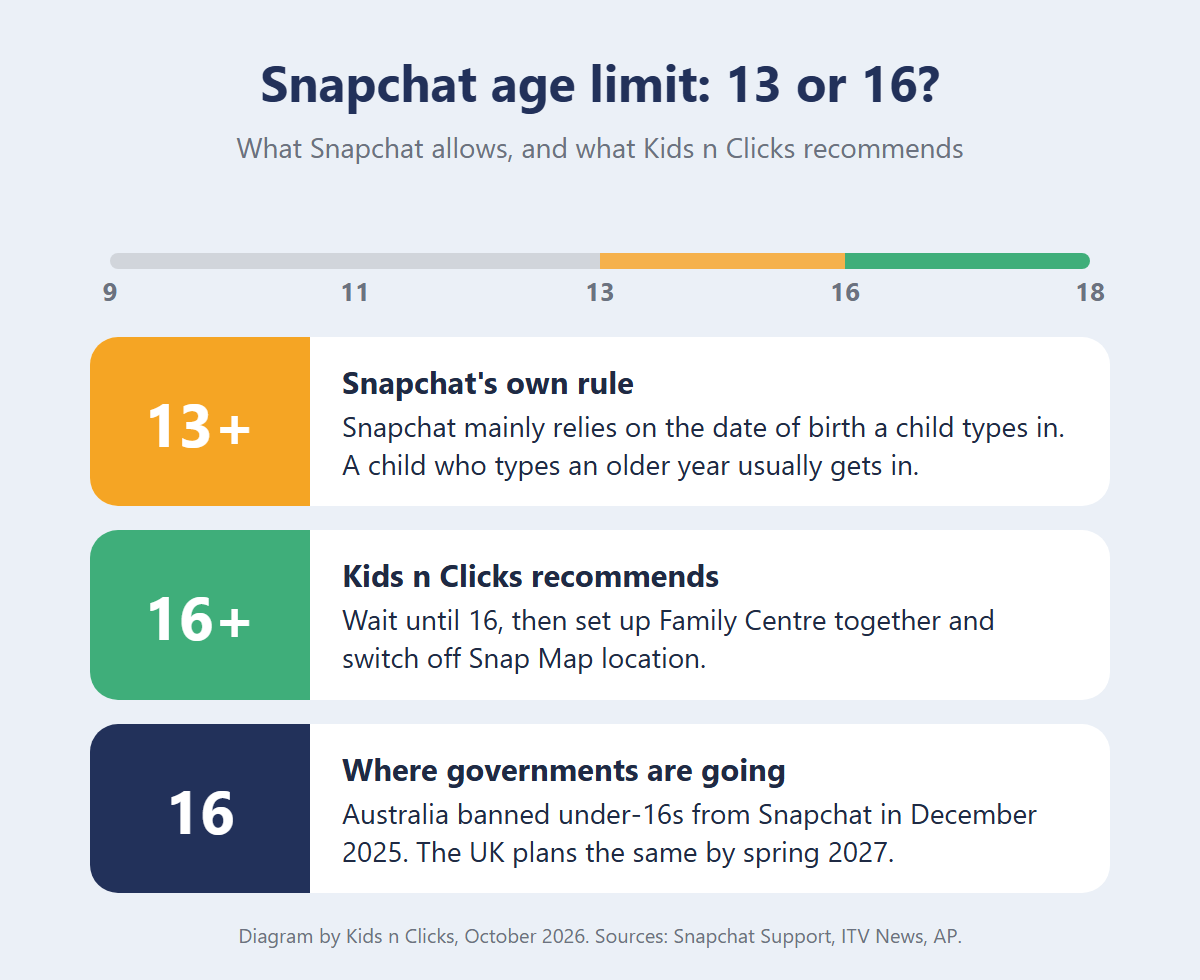
Short answer: The Snapchat age limit is 13. Snapchat says so in its own help pages, but it mainly relies on the date of birth a child types in, so younger children get in easily. Kids n Clicks recommends waiting until 16. UK police link Snapchat to more grooming offences than any other app, child sextortion reports are rising fast, and Snap Map can show a stranger where a child is. Australia already bans under-16s from Snapchat, and the UK plans to do the same by spring 2027.
In short:
- Snapchat’s official minimum age is 13, but 72% of UK children aged 8 to 12 use apps with a minimum age of 13 (Ofcom, 2025).
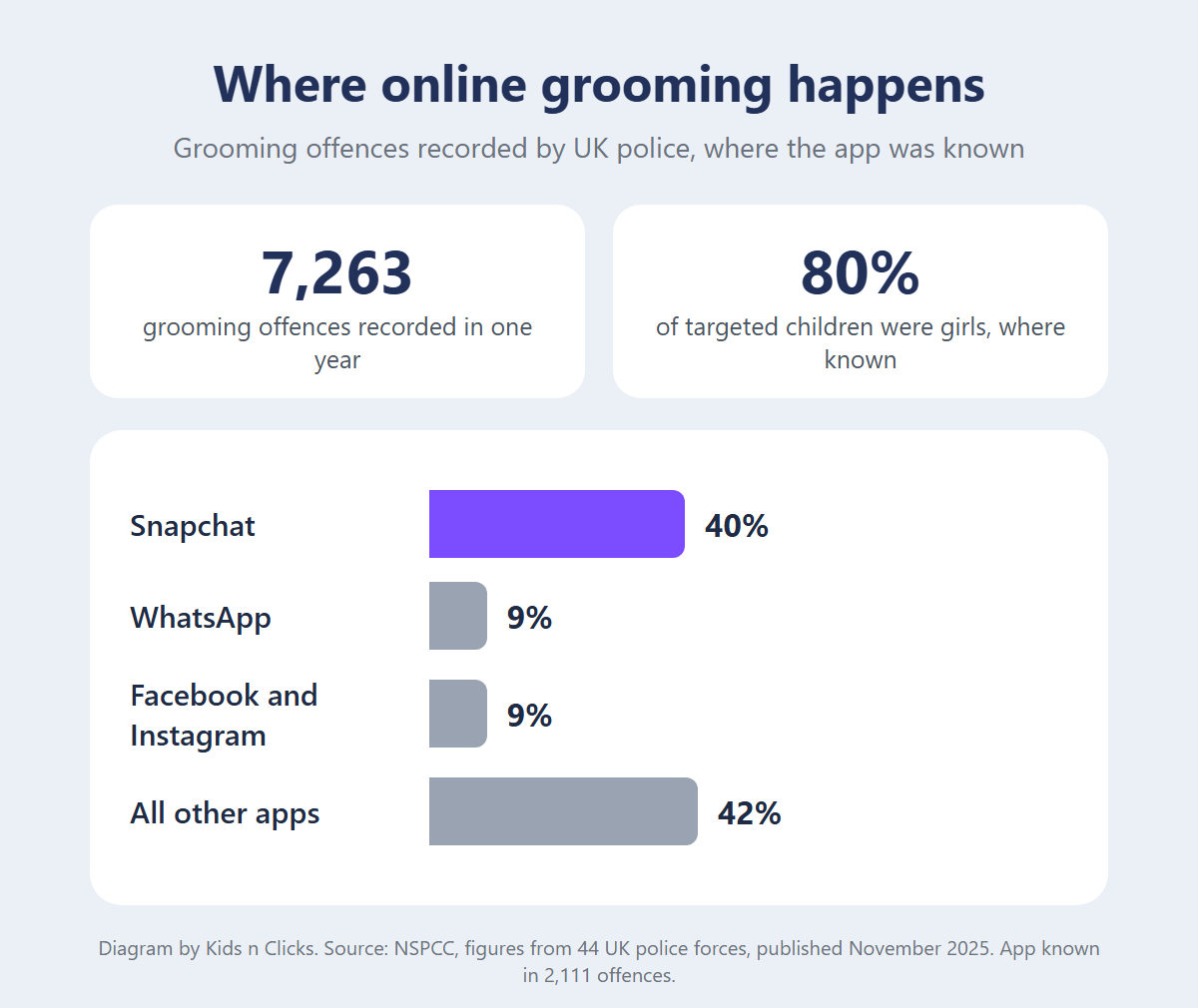
- Where UK police could identify the app, 40% of online grooming offences happened on Snapchat (NSPCC, 2025).
- Confirmed child sextortion reports rose 72% in a year, and 97% of the victims were boys (Internet Watch Foundation, 2025).
- Kids n Clicks recommends 16, the same age Australia already enforces and the UK plans to enforce from spring 2027.
- When your child does join, set up Family Centre together, switch on Ghost Mode in Snap Map, and keep chat to friends only.
What is the Snapchat age limit?
The Snapchat age limit is 13. Snapchat’s own safety page puts it plainly: Snapchat is for ages 13 and over.
How old do you have to be to have Snapchat?
You have to be 13 to have Snapchat, by Snapchat’s own rules. Apple’s App Store gives Snapchat the same age rating: 13+. Neither number means Snapchat is safe at 13. It only means Snapchat does not allow younger children. Kids n Clicks recommends waiting until 16.
In practice, that limit is easy to get round. When a child signs up, Snapchat asks for a date of birth. A 10 year old who types an older year usually gets an account. Ofcom found that 72% of children aged 8 to 12 use sites and apps with a minimum age of 13, and in March 2026 it told the big platforms, Snapchat included, to keep underage children off.
What the news says about Snapchat and children
Three reports from the past year explain why so many parents now ask about the Snapchat age limit.
ITV News, June 2026. ITV News asked 37 UK police forces about crimes linked to Snapchat. The forces recorded more than 100,000 offences involving the app over five years, including rape and sexual assault. Where police gave the victim’s age, six in ten were children, and the youngest was seven. ITV also reported that offenders use Snap Map to find children in real life, including at school.
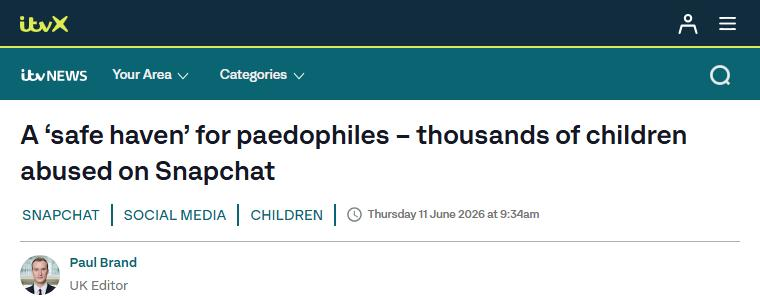
Screenshot: ITV News, 11 June 2026
In the same report, the National Crime Agency said it receives around 400 referrals of possible child abuse from tech companies every day, and about 100 of those come from Snapchat. Snapchat told ITV that it works closely with the police and keeps changing its safety tools as criminals change their methods.
NSPCC, November 2025. The NSPCC collected figures from 44 UK police forces. Police recorded 7,263 offences of sexual communication with a child in one year, almost double the figure from 2017/18. Where police could tell which app the offender used, Snapchat came top by a wide margin.
Screenshot: NSPCC, 13 November 2025
UK government, June 2026. Prime Minister Keir Starmer announced that under-16s in the UK will lose access to Snapchat, Instagram, Facebook, TikTok, X and YouTube. WhatsApp is not included. The government hopes to bring the ban in around spring 2027, and Ofcom will enforce it.
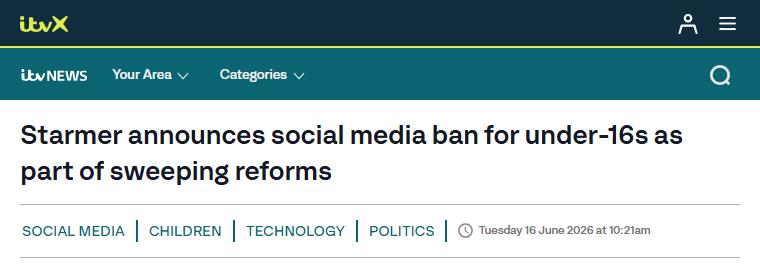
Screenshot: ITV News, 16 June 2026
Snapchat and sextortion: the figures
Sextortion is blackmail using a sexual image. Someone, usually pretending to be a teenager, persuades a child to send a photo, then threatens to share it with their friends and family unless the child pays or sends more. Our post on sextortion covers how it happens and what to do in the first hour.
The Internet Watch Foundation confirmed 153 child sextortion cases in the first half of 2025, up from 89 in the same months of 2024. Boys made up 97% of the victims. Snap itself said in June 2026 that it acts on around 220 suspected sextortion cases every day, worldwide.
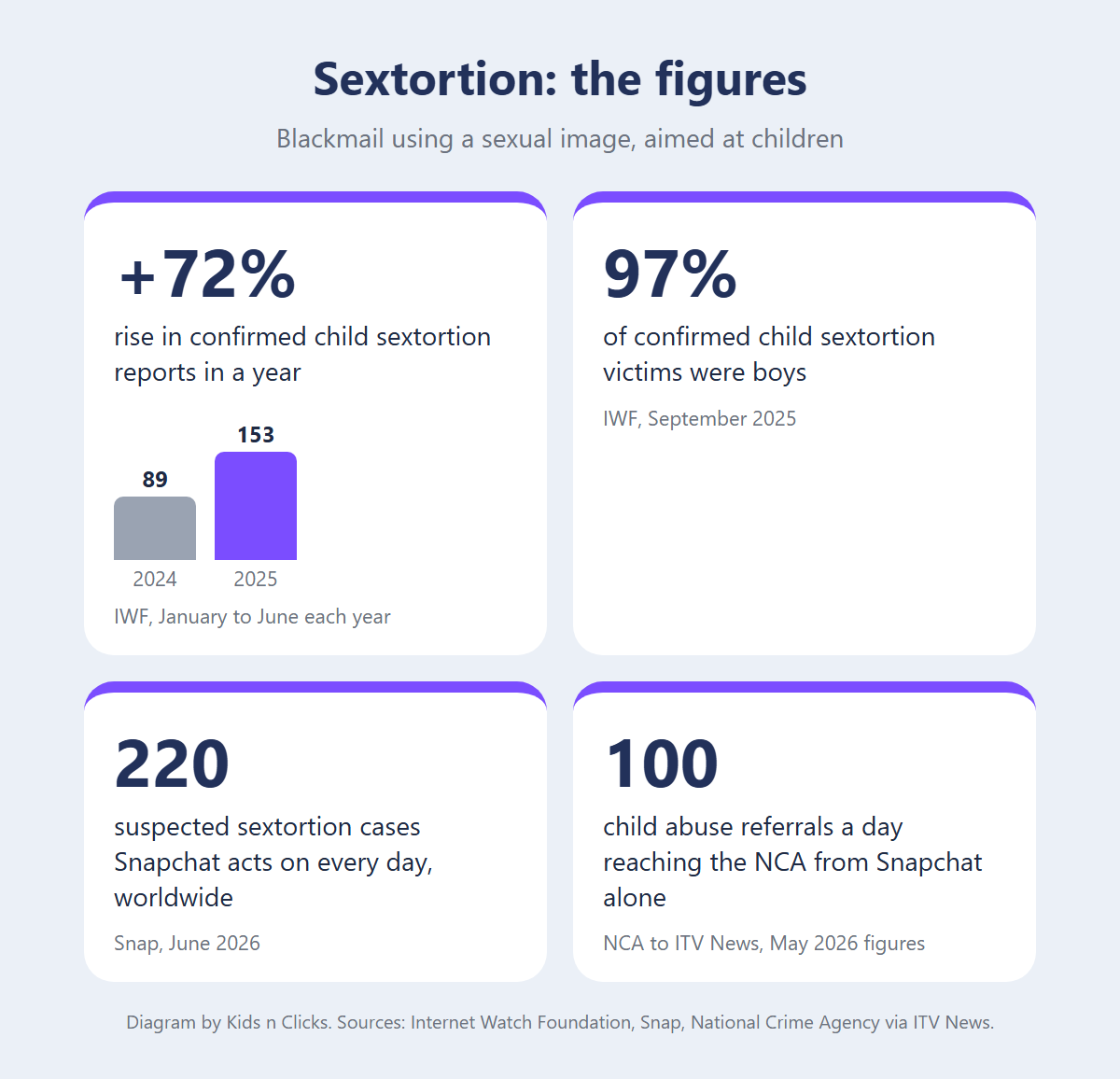
Boys are the main target, which surprises most parents. The NSPCC found that offenders often set up several fake profiles and move children from one app to another, so a chat that starts in a game can end up on Snapchat, where messages disappear.
Why Kids n Clicks puts the Snapchat age limit at 16
Snapchat is not dangerous because of one feature. A handful of features, all switched on in the same app, make it easier for a stranger to find a child and harder for a parent to see what happened.
| Snapchat feature | What it does | Why it worries parents |
|---|---|---|
| Snap Map | Shows friends where your child is on a map, if location sharing is on | ITV found offenders using it to find children near home and school |
| Quick Add | Suggests people your child might know | It can put your child in front of strangers who live nearby or share friends |
| Disappearing messages | Deletes snaps and chats after they are viewed | Children feel a photo is safe to send, and parents find no trace afterwards |
| Snapstreaks | Counts how many days in a row two people send each other snaps | Children feel pressure to keep the streak going, every single day |
| My AI | A chatbot that sits at the top of the chat list | Children talk to it like a friend and may tell it personal things |
A 13 year old finds it much harder than a 16 year old to tell when a stranger is pretending to be their age. Younger children also tend to keep quiet when something goes wrong, because they fear losing their phone. That is why Kids n Clicks puts the Snapchat age limit at 16, the same age Australia already enforces and the UK plans to adopt.
Not everyone agrees that a ban is the answer. The NSPCC and the National Crime Agency told ITV they would rather see apps remove the dangerous features, because children find ways round bans. A delay at home does not depend on the law, though. Parents can set their own Snapchat age limit of 16 today.
Parven explains Snapstreaks, and why children find them so hard to break, in this short video:

Which countries ban social media for under-16s?
More than 20 countries are now limiting social media for children, and Australia has already put the Snapchat age limit at 16 in law. These are the clearest cases, as reported by AP in June 2026:
| Country | Age | Where it stands |
|---|---|---|
| Australia | Under 16 | In force since December 2025. Snapchat, Instagram, TikTok, YouTube, Facebook, X and others must remove under-16 accounts. Snapchat said it had blocked or disabled 415,000 Australian accounts by the end of January 2026. |
| United Kingdom | Under 16 | Announced in June 2026. Covers Snapchat, Instagram, Facebook, TikTok, X and YouTube, but not WhatsApp. Planned for around spring 2027. |
| Malaysia | Under 16 | Large platforms must check ages and stop under-16s opening accounts. |
| Indonesia | Under 16 | Announced in March 2026 for platforms it treats as risky, including YouTube, TikTok, Instagram and Roblox. |
| Denmark | Under 15 | The government plans a ban on several social media platforms. |
| Brazil | Under 16 | Not a ban. Since March 2026, under-16s must link their account to a parent or guardian. |
These bans do not keep every child out. Ian Russell, whose daughter Molly died after viewing harmful content online, told ITV’s Good Morning Britain that over 60% of the 13 to 15 year olds the Australian ban covers are still online. Settings and conversations at home still matter, whatever the law says.
How to set up Snapchat safely when your child is ready
Is Snapchat safe once your child is older? Safer, if you change the settings. When your child reaches 16, or if they already have Snapchat below the age Kids n Clicks recommends, these steps cut the biggest risks.
Step 1: Set up Family Centre together. Family Centre lets a parent see who their teenager has chatted with in the last seven days, without reading the messages. It also lets you limit sensitive content in Stories and Spotlight, switch off My AI, and report worrying accounts. Install Snapchat on your own phone, add your child as a friend, then open Family Centre from your profile. Do it with your child, not behind their back.
Step 2: Switch on Ghost Mode. In Snap Map, tap the settings cog and turn on Ghost Mode. Your child’s location then stays hidden from everyone.
Step 3: Keep chat to friends only. In Settings, under Privacy Controls, set Contact Me and View My Story to My Friends, and turn off See Me in Quick Add.
Step 4: Talk about the first message from a stranger. Tell your child plainly: if anyone you do not know in real life adds you, asks for a photo, or asks you to move to another app, come and tell us, and you will not lose your phone. Children who expect to lose the phone tend to deal with frightening things alone.
Parven explains how online grooming works, using a real Snapchat case involving a 13 year old, in this video:

If something has already gone wrong, a child can report a nude image of themselves through the Report Remove service run by Childline and the Internet Watch Foundation, and you can report grooming to CEOP, the child protection command of the National Crime Agency. If your child does not have a phone yet, our post on a smartphone free childhood covers how other families delay it.
TikTok, Snapchat and social media training
Our TikTok, Snapchat and Trending Social Media Deep Dive covers this properly: how Snap Map, disappearing messages, streaks and My AI really work, who can contact a child on Snapchat, and which privacy settings parents should check first.
It is a practical session that takes parents inside the apps their children use, rather than another list of online risks. It lasts one hour, runs online, and has no minimum or maximum group size, so it works for schools, parents’ groups, community organisations and employers who want to support the working parents in their team.
If you run a school, a parents’ group or a workplace, book the social media session here or connect with Parven on LinkedIn.
Parven Kaur is a digital parenting and online safety expert, and the founder of Kids n Clicks. She won the Scottish Cyber Security Award, and she sits on the National Board of Advisors for Barnardo’s Scotland.
Was this helpful?
Good job! Please give your positive feedback
How could we improve this post? Please Help us.